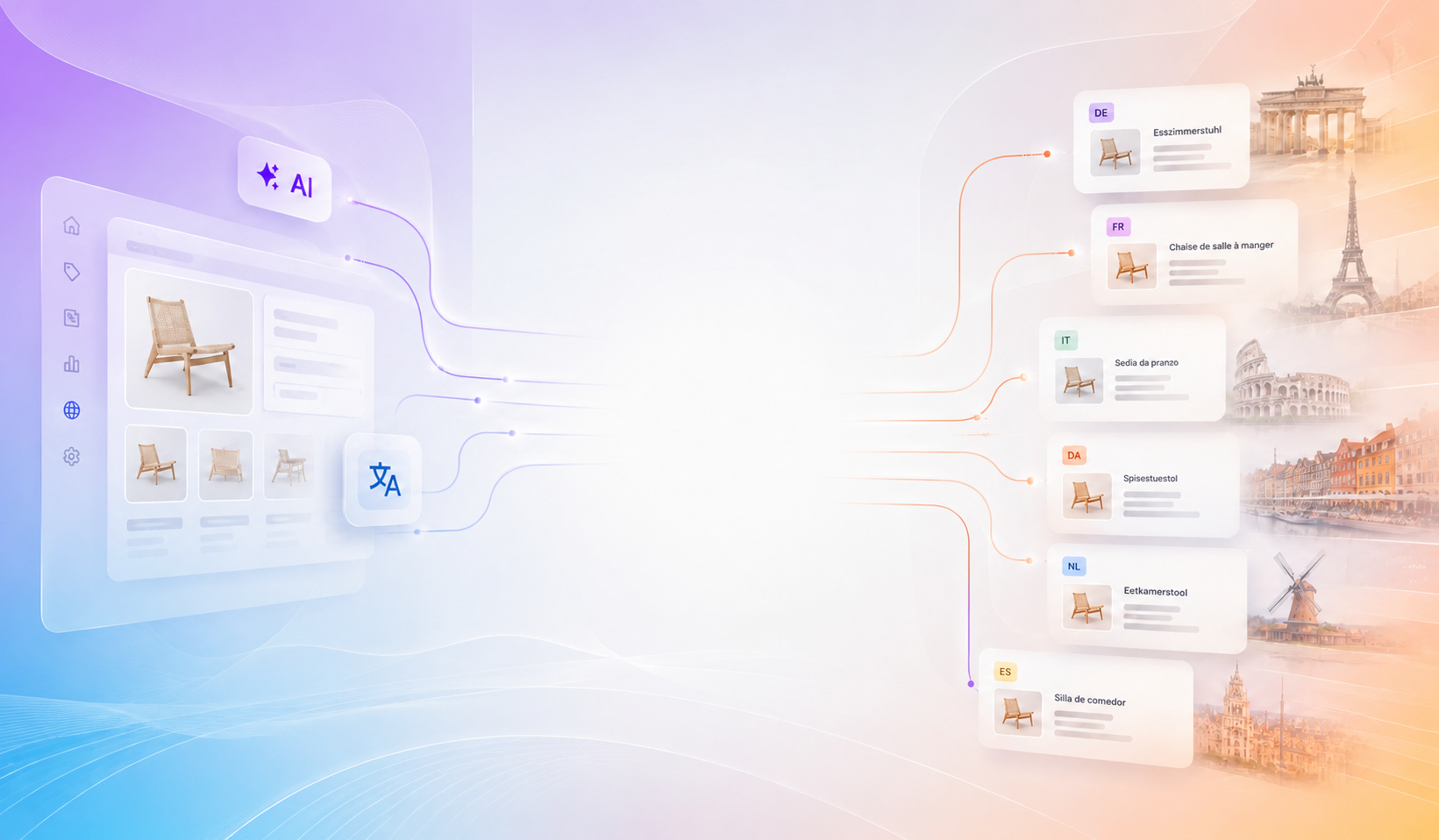
AI does not remove the need for judgment, brand control or local market understanding. But it does change the economics of getting commerce content into shape for more than one market. For European shops in particular, that matters because language is not a cosmetic detail. It is often the difference between feeling local enough to buy from and feeling foreign enough to leave.
Why language still matters in EU commerce
Europe is commercially dense but linguistically fragmented. A merchant can reach meaningful demand in Denmark, Germany, France, Italy, the Netherlands, Spain and beyond without changing the fundamentals of the catalog or offer, but customers still expect the storefront experience to meet them in their own language.
That expectation is not limited to homepages and campaign copy. It shows up in product names, descriptions, variant labels, materials, editorial storytelling, merchandising text and the operational details that influence trust. If the buying journey feels half translated, it usually feels half ready.
Local language improves clarity at the exact moment a customer is evaluating fit, finish, size, delivery and trust.
Localized product content makes paid acquisition and SEO in each market more credible.
Merchants can test demand in more markets earlier instead of waiting for a heavyweight localization process.
What changed with AI localization
The shift is not just that machine translation exists. The real shift is that modern AI models can be wired directly into the systems where content already lives, so localization becomes a working operational flow instead of an export-import ritual.
In the translations app we have been building, the workflow is embedded directly into the admin surface. The app can discover the languages configured in the platform, show which translations already exist, let a merchant pick a target language, and translate from the source language into the missing locale without leaving the content tree.
That matters because speed is not only about model latency. Speed comes from eliminating handoffs: no copying product data into separate documents, no manually tracking which variant labels are still missing, and no rebuilding structure that the commerce platform already understands.
A better fit for how shops actually manage catalog content
The Thor Commerce side of the app is especially practical because it is not only translating a single product title. It can work across products, variants, attributes and attribute values, and it can do that in bulk where it makes sense. A merchant can translate a product and also translate every related variant, or translate an attribute and its values as one operation.
That is the kind of detail that makes the difference between a demo and a useful tool. Real catalogs are not flat. If a merchant wants to launch a new market, they need more than a translated hero line. They need variant names, option values, supporting metadata and descriptive text to move together in a way the storefront can actually use.
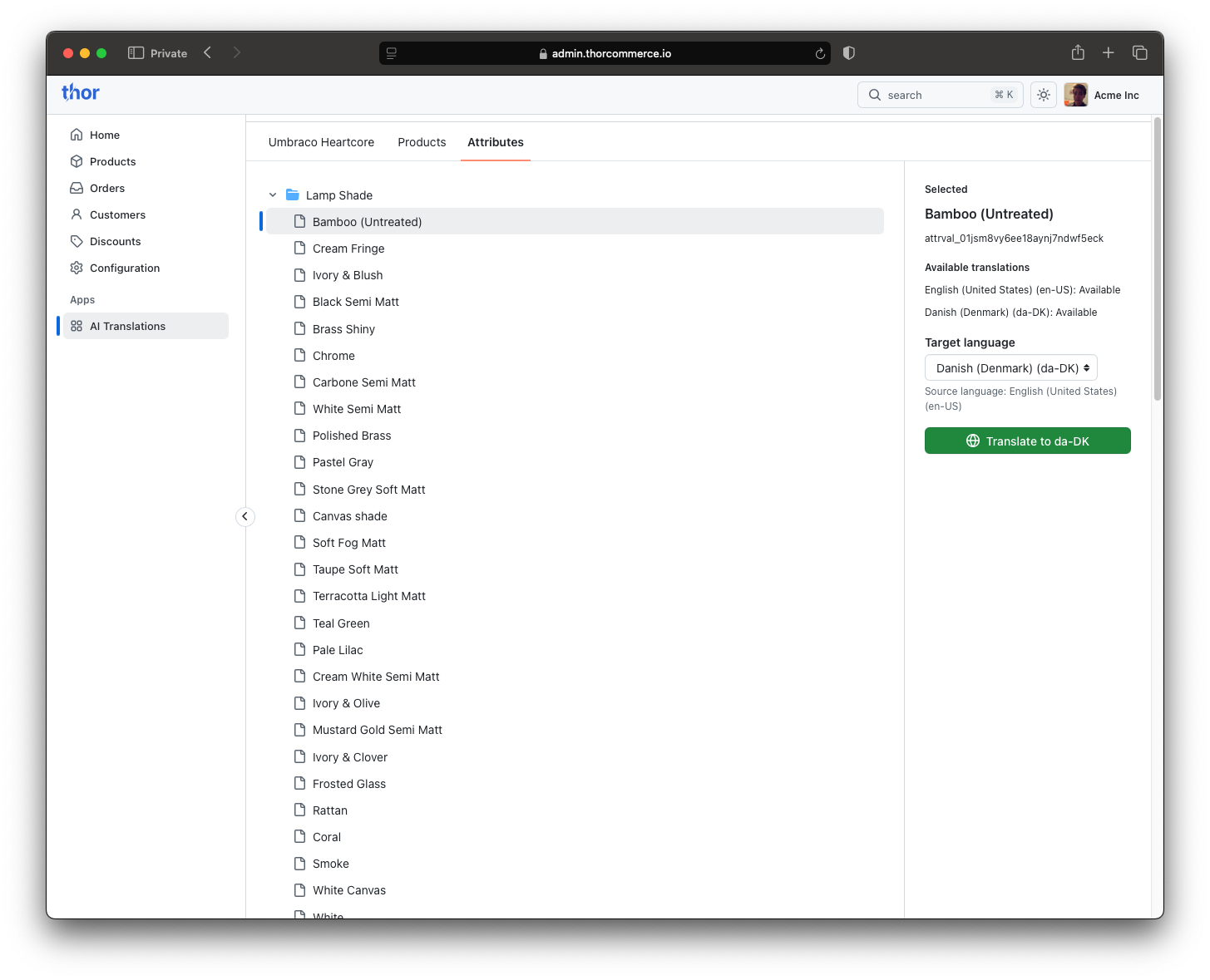
The current implementation also keeps track of translation completeness per language, so teams can see which locales are available and which are still missing. That makes localization easier to operate as an ongoing merchandising task rather than a one-time content migration.
The screenshot above shows why this matters in practice: localization becomes something a commerce team can operate directly from the product tree, with target-language selection, visibility into what is missing, and a faster path from source content to market-ready output.
Brand matters, not just language
Good localization for commerce is not about swapping words one-for-one. The prompt layer in the app is written to preserve brand tone, product naming rules, formatting and content structure. In the GUBI-oriented setup, for example, core product names, collection names, designer names and model identifiers are preserved, while descriptive qualifiers are localized where that is appropriate.
That is a more realistic way to use AI in commerce. Merchants do not want their naming systems dissolved by generic translation. They want the brand-specific logic to survive while the surrounding content becomes native to the target market.
Why this lowers the cost of market expansion
For a lot of commerce teams, the barrier to entering another market is not only tax, logistics or payments. It is the operational cost of making the storefront feel ready. If every new locale means weeks of manual content work, expansion gets pushed down the roadmap.
AI localization changes that math. When a team can translate directly from the source system, reuse the platform's own language setup, and generate target-market content in batches, the cost of preparing a second or third language drops sharply. That does not make every market automatically profitable, but it does make testing more affordable and iteration much faster.
This is where the combination of AI and modern developer tooling becomes interesting. You do not need to wait for a monolithic vendor suite to decide your workflow for you. A team can build a focused internal app around its real content model, platform APIs and editorial rules. With tools like Codex, it is much easier to stand up that kind of operational utility than it used to be.
Faster does not mean careless
The strong use case is not “publish raw AI everywhere and hope for the best.” The better use case is to remove repetitive translation work, preserve structure, and let teams review or publish with much less manual effort than before. In the Umbraco/Heartcore side of the app, there is even an explicit publish setting so teams can choose whether translation should stop at draft or go live immediately.
That is the right framing for AI localization in commerce: faster, cheaper and more operational, but still connected to human approval where the business needs it.
The strategic takeaway
If you sell in Europe, language coverage is one of the most practical levers for expanding reach without reinventing your business. The merchants who benefit most will not be the ones with the most grand theory about AI. They will be the ones who turn localization into a reliable workflow inside the systems they already use.
That is why AI localization fits so well with commerce. It is not just about translating content. It is about reducing the cost of entering markets, accelerating launch readiness and making multilingual commerce operationally realistic for more teams than before.