
From 27 September 2026, ecommerce businesses selling consumer goods in the European Union will face new point-of-sale information requirements for guarantees.
The change introduces two connected elements: a harmonised notice explaining consumers’ legal guarantee rights, and the EU GARAN label for products covered by a qualifying commercial durability guarantee. They are designed to work together, but they do not apply in the same way.
For commerce teams, this is more than a legal-copy update. The notice must be placed clearly on the selling interface, while the GARAN label must remain associated with the specific product it covers. That makes implementation a product-data, storefront and operational task.
What changes on 27 September 2026
Directive (EU) 2024/825 on empowering consumers for the green transition amends the Consumer Rights Directive and the Unfair Commercial Practices Directive. Member States had until 27 March 2026 to transpose it, and its rules apply from 27 September 2026.
The harmonised guarantee notice and GARAN label were established through Commission Implementing Regulation (EU) 2025/1960.
The objective is to make the distinction between legal guarantee rights and voluntary commercial guarantees easier for consumers to understand at the point of sale.
Two guarantee messages, with different scope
The most important implementation detail is that the legal-guarantee notice and the GARAN label are not interchangeable.
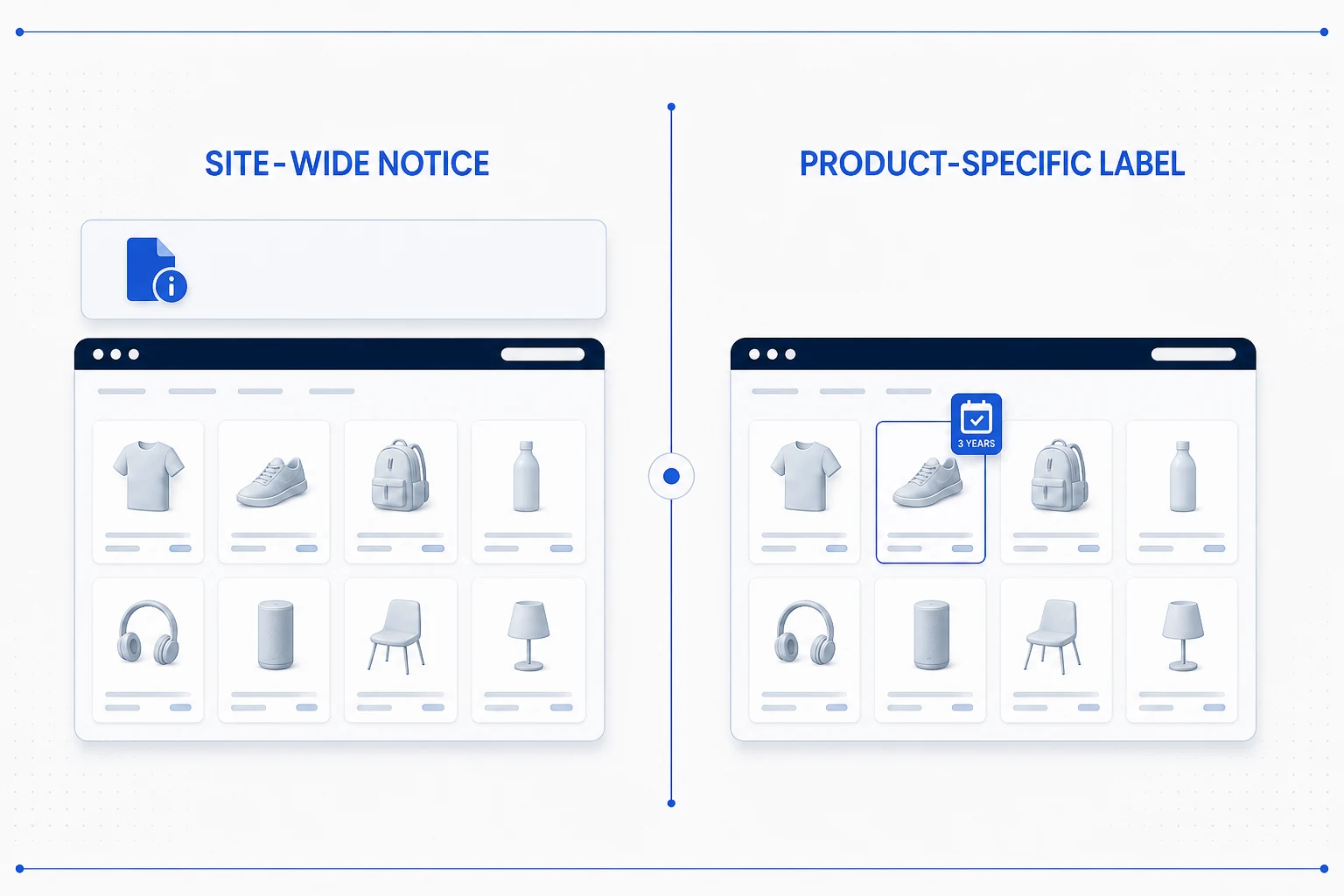
The legal-guarantee notice applies broadly
Sellers of consumer goods in the EU must display the harmonised notice prominently. It reminds consumers that goods sold in the EU carry legal guarantee protection of at least two years, although some Member States provide a longer period.
For ecommerce, the European Commission describes the notice as a general reminder on the seller’s website. When displayed online, it must appear in colour. Its standard format, including its QR code, must not be modified.
This notice concerns the consumer’s statutory rights against the seller when goods are faulty. It applies independently of whether a producer offers an additional commercial guarantee.
The GARAN label is product-specific
The GARAN label applies when a producer offers a voluntary commercial guarantee of durability that meets all three conditions:
It is provided at no additional cost to the consumer.
It covers the entire product rather than only one component.
It lasts for more than two years.
Offering such a guarantee is voluntary. Once a producer offers a guarantee meeting those conditions and makes the information available to the seller, use of the harmonised GARAN label becomes mandatory.
A guarantee covering only one component does not qualify for the label. Other commercial guarantees may still be offered, but they must not be presented in a way that could confuse consumers about what the GARAN label represents.
What the GARAN label communicates
The label represents a producer’s commitment that the product will maintain its required functions and performance during normal use for the stated number of years. If it does not, the producer must repair or replace the product at no cost under the commercial guarantee.
The label has a fixed EU design containing the GARAN title, a durability tick, a calendar symbol, a reminder about the legal guarantee and a QR code. Online versions must appear in colour. The Commission also permits a nested online presentation that expands after a first click or pointer interaction.
The producer must adapt only the permitted product-specific elements:
The number of years covered by the durability guarantee.
The producer’s brand or trademark.
The model identifier showing exactly which product is covered.
For online sales, the label should be placed directly next to the picture of the covered product or otherwise displayed so that consumers can immediately see which product benefits from the guarantee. A generic GARAN badge detached from the relevant product is not enough.
The commercial guarantee statement still matters
The label does not replace the detailed commercial guarantee statement. The consumer must receive that statement in a durable form they can retain, such as paper or email, no later than delivery.
According to the European Commission’s business guidance, the statement should include:
Confirmation that the consumer’s legal right to free remedies from the seller is not affected by the commercial guarantee.
The producer’s name and address.
The steps required to use the commercial guarantee.
The goods covered by it.
The conditions that apply.
This means the product-page label, the underlying guarantee data and the post-purchase documentation need to agree.
Why this becomes a commerce-platform problem
The visible label is only the final step. Before a storefront can display it correctly, the commerce stack needs reliable product-level information from the producer.
Teams need to know whether a guarantee qualifies, how long it lasts, which model it covers, which producer stands behind it and where the complete terms are stored. That information must remain consistent across product pages, localisation, marketplaces, checkout-adjacent surfaces and order communications.
The distinction between producer and seller also matters. Producers are responsible for supplying the relevant durability-guarantee information. Sellers are responsible for making the qualifying label clearly visible to consumers when that information has been made available.
For multi-market businesses, the harmonised assets are available in EU languages, but implementation still needs to account for the consumer’s market and language without changing the regulated design.
What ecommerce teams should prepare now
Preparation should begin with an audit of guarantee information and every interface where products are offered to EU consumers.
Identify the storefronts and sales channels selling consumer goods in the EU.
Add the harmonised legal-guarantee notice as a prominent general reminder on each relevant ecommerce site.
Use the official colour notice and preserve its design and QR code.
Ask producers which products carry commercial durability guarantees longer than two years.
Confirm that each qualifying guarantee is free and covers the entire product.
Model guarantee duration, producer, brand and model ID as structured product data.
Associate each GARAN label with the exact product or model it covers.
Use the official colour label online and test any expandable presentation for accessibility.
Ensure the detailed commercial guarantee statement is delivered in a durable form no later than product delivery.
Review localisation, responsive layouts and all supported sales channels.
Assign ownership for keeping guarantee data, label presentation and guarantee terms aligned.
Have legal counsel review the implementation in each market where necessary.
The European Commission provides official business guidance and downloadable label resources. Teams should use those official assets rather than recreating the notice or label.
The takeaway
From 27 September 2026, every relevant EU ecommerce seller needs to distinguish clearly between the mandatory notice about legal guarantee rights and the product-specific GARAN label.
The notice is a general point-of-sale requirement. The GARAN label is required only where a producer offers a qualifying commercial durability guarantee, but it must then stay visibly connected to the exact product it covers.
The businesses that prepare well will treat this as structured commerce information rather than a last-minute badge. Product data, storefront presentation and guarantee documentation all need to tell the same story.
Questions about preparing your commerce setup for the new guarantee requirements? Contact hello@thorcommerce.io.
This article provides general information and should not be treated as legal advice.